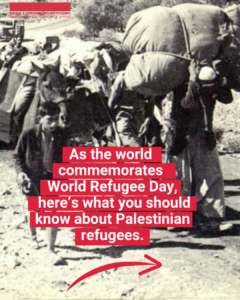



As the world marks World Refugee Day each year on June 20th, for Palestinian refugees, this day comes with particular significance, as millions of Palestinian refugees
Slide 1:
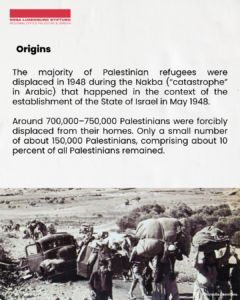
Origins
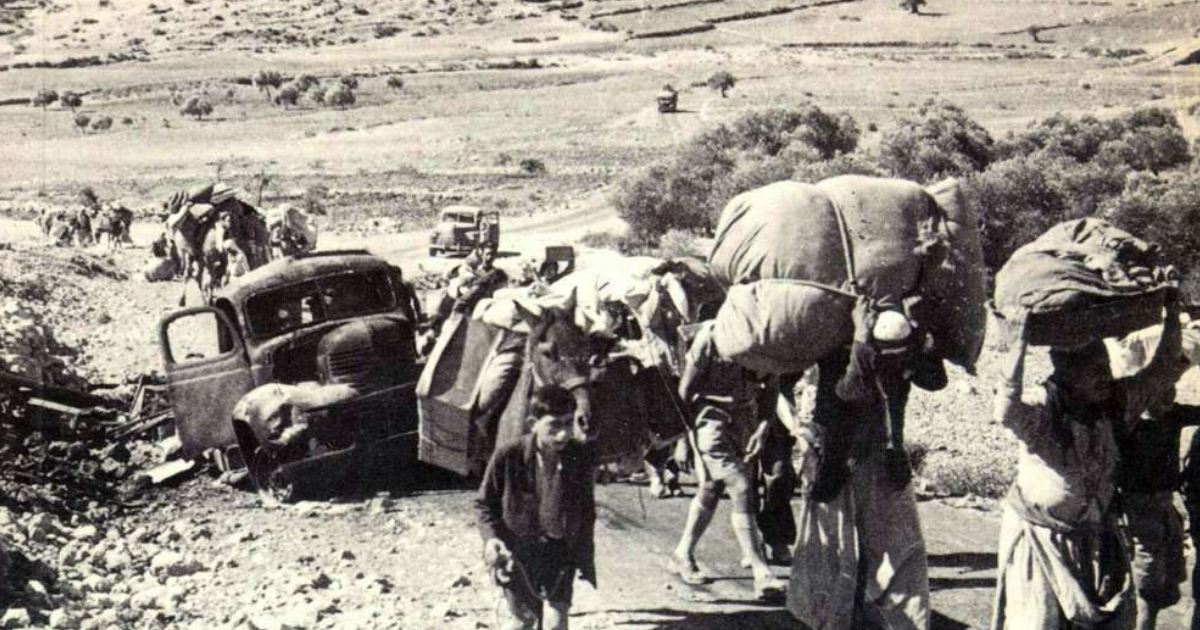
The majority of Palestinian refugees were displaced in 1948 during the Nakba (“catastrophe” in Arabic), which refers to the forcible displacement of around 700,000–750,000 Palestinians from their homes which led to the establishment of the state of Israel.
Slide 2:
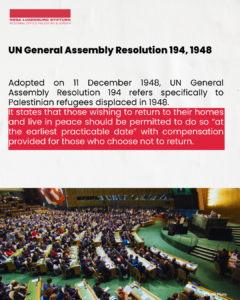
UN General Assembly Resolution 194, 1948
Adopted on 11 December 1948, UN General Assembly Resolution 194 refers specifically to Palestinian refugees displaced in 1948. It states that those wishing to return to their homes and live in peace should be permitted to do so “at the earliest practicable date” with compensation provided for those who choose not to return.
Slide 3:
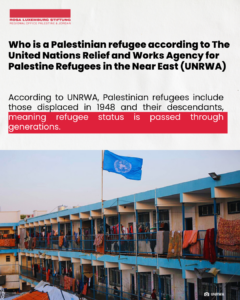
Who is a refugee? (UNRWA definition)
According to UNRWA, Palestinian refugees include those displaced in 1948 and their descendants, meaning refugee status is passed through generations.
Slide 4:
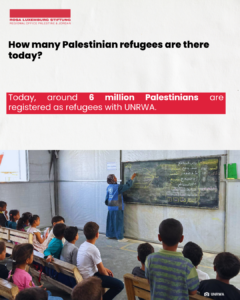
How many refugees?
Today, around 6 million Palestinians are registered as refugees with UNRWA, with broader estimates varying depending on definitions used.
Slide 5:
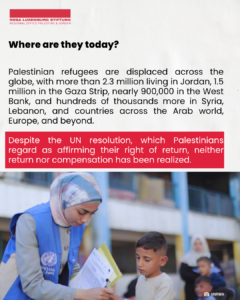
Where are they today?
Palestinian refugees are displaced across the globe, with more than 2.3 million living in Jordan, 1.5 million in the Gaza Strip, nearly 900,000 in the West Bank, and hundreds of thousands more in Syria, Lebanon, and countries across the Arab world, Europe, the Americas, and Oceania.
As the world commemorates World Refugee Day, Palestinian refugees are still being denied their right of return since 1948.
Intro:
As the world marks World Refugee Day each year on June 20th, for Palestinian refugees, this day comes with particular significance, as millions of Palestinian refugees have been denied their right of return since 1948, following the forcible displacement that Palestinians refer to as the Nakba (meaning “catastrophe” in Arabic), which led to the establishment of the state of Israel.
Slide through the post for more info about this matter.
Slide 1:
As the world commemorates World Refugee Day, Palestinian refugees are still being denied their right of return since 1948.
Slide 2:
How did Palestinians become refugees?
- The term Palestinian refugees refers to Palestinians who lost their homes and were forcibly displaced during the Nakba of 1948, which took place alongside the establishment of the State of Israel, and in the period that followed. Over 750,000 Palestinians were displaced from their homes and lands, and now their numbers count to over 5 million refugees.
- Palestinian refugees are displaced across the globe, with more than 2.3 million living in Jordan, 1.5 million in the Gaza Strip, nearly 900,000 in the West Bank, and hundreds of thousands more in Syria, Lebanon, and countries across the Arab world, Europe, the Americas, and Oceania.
Slide 3
What is the right of return?
- The right of return is the principle that refugees have the right to return to the homes and lands from which they were displaced.
- The Palestinian right of return is recognized in international law and is reflected in the Universal Declaration of Human Rights and UN Resolution 194.
- The resolution asserted that refugees have an individual right to return to the homes and lands they were forced to leave, and this right cannot be unilaterally denied or waived by others.
Slide 4
On World Refugee Day, we remember that the Palestinian refugee question remains unresolved, and that millions continue to live in exile, holding on to their right of return.
Slide 5:
Sources