



Originally published by Rosalux.de
To read the full study, click here
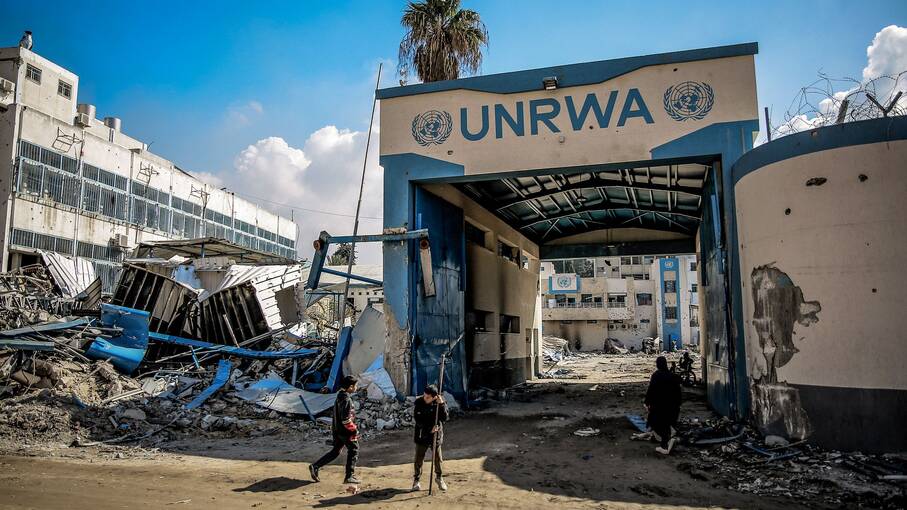
This study, commissioned by the Rosa Luxemburg Foundation, provides a systematic insight into the advocacy work of pro-Israel political actors in the USA, Germany, and Israel for the first time. It’s central concern is the political campaign against the United Nations Relief and Works Agency for Palestine Refugees in the Near East (UNRWA), which has existed since 1949.
The study traces the strategies and argumentative patterns used to discredit UNRWA and its work within the German political landscape, with the medium term aim of ending the agency’s funding. Using this case as an example, the study makes an important contribution to a fact-based and systematic understanding of the working methods as well as the personal and political networks of pro-Israel organizations. It becomes clear how these actors influence political, social, and media debates in Germany, and what impact they have had on decisions made by governments and parliaments regarding Israel-Palestine policy.
The United Nations and its institutions operating in Israel and Palestine have long stood at the center of a polarized political conflict over the catastrophic situation on the ground. This has been especially true since the massacre executed by Hamas in southern Israel on October 7, 2023, and the subsequent genocidal war waged by Israel against the Palestinians in the Gaza Strip. There is an intensification of political and media debates against the backdrop of ongoing attacks on international law and the UN institutions bound by it. The temporary suspension of German financial aid to UNRWA in early 2024 illustrates the political consequences of this development. Currently the agency is suffering significant funding gaps that hinder its work and further exacerbate the catastrophic humanitarian situation of Palestinians, not only in the Gaza Strip. As one of the most important donor countries, Germany plays a decisive role here. Accordingly, intense political campaigns are being conducted in Germany aimed at ending funding and thus effectively weakening UNRWA.
Given the highly polarized debate over the situation in Israel and Palestine, it is a particular concern of the Rosa Luxemburg Stiftung to approach this politically and socially highly relevant topic with the greatest possible care. This is especially true against the backdrop of the continuing potency of antisemitic conspiracy narratives about an alleged “Jewish” or “Zionist world domination,” as recently became visible again in connection with antisemitically coded narratives surrounding the “Epstein files.” At the same time, we are witnessing an increasing narrowing of pluralistic discourse spaces (“shrinking spaces”) in the German-language debate about Israel and Palestine. In the context of worldwide authoritarian developments, this trend poses a considerable danger to democratic societies.
Moreover, the present study demonstrates that access of political advocacy actors to political decision-makers in this field is very unevenly distributed. Precisely for this reason, a transparent and critical examination of political influence is called for. This is all the more true given that Germany has institutions and civil society organizations that are committed to the transparency of political decision-making processes and to limiting lobbying influence, at least in principle.
The meticulous research of our author Alon Sahar—founder of the Substack page Staatsräson Monitor and, among other things, active with the Israeli human rights organizations B’Tselem and Breaking the Silence— makes key actors of the “anti-UNRWA network” in the USA, Israel, and Germany visible. The study brings into the light how these actors — fulfilling different roles — work toward achieving the adoption of their political demands in Germany through the dissemination and repetition of certain narratives. In parts, this process unfolds in disregard of basic standards of political transparency that are essential for a well-founded German Middle East policy and for a pluralistic debate on preventing antisemitism.
This appears all the more urgent given that considerable public funds have been spent on maintaining these structures. The study assumes that disclosing the political structures and the actors shaping them is necessary in order to better understand and assess political influence in the field of Israel-Palestine policy in Germany. We therefore understand this study as an invitation to dialogue with all those who wish to work, on the basis of systematically researched knowledge, against the tendency toward narrowing the political debate.
Gil Shohat, Director of the Rosa Luxemburg Stiftung’s Israel Office
Author
Alon Sahar is a German-Israeli independent researcher, strategic consultant, and filmmaker. His analyses and commentaries have been published in leading international media outlets, including Der Spiegel, EUobserver, The Jerusalem Post, and Verfassungsblog. He has collaborated on research projects with Breaking the Silence and B’Tselem and is the founding editor of the Staatsräson Monitor.