


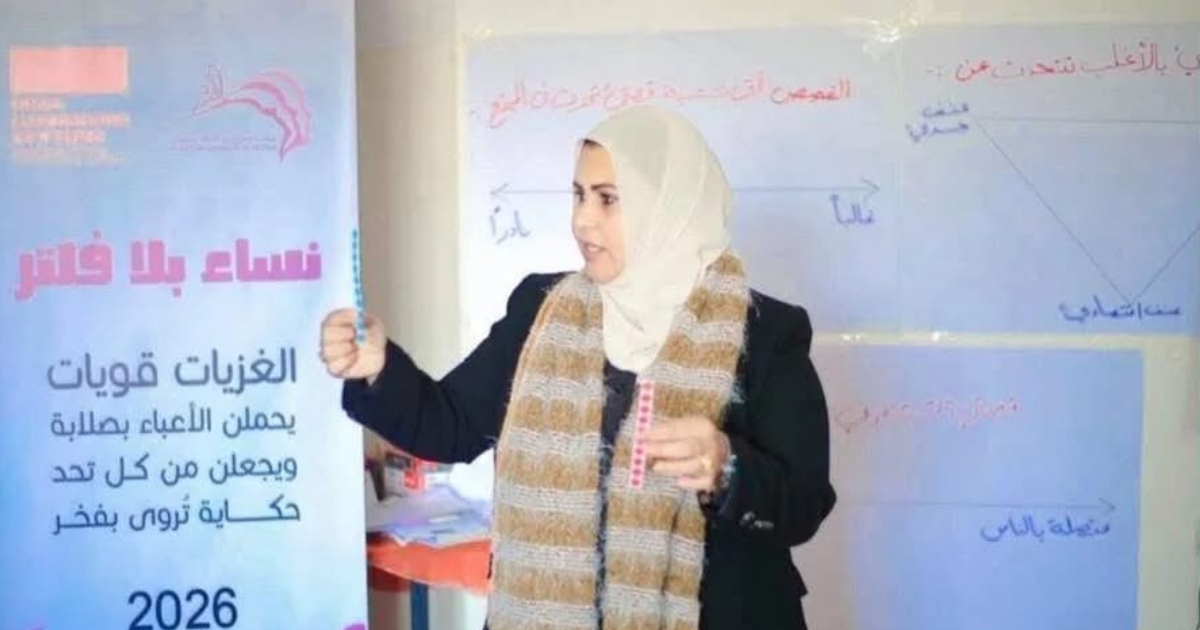

Wisam Al-Deirawi, Executive Director of Buzoor Theater, RLS partner in Gaza. spoke with Katja Hermann, the head of the Palestine and Jordan Regional Office of the Rosa-Luxemburg-Stiftung (RLS) about the psychological burden facing women in Gaza and how art has become a tool for healing.
Interview originally published on Rosalux.de
How would you describe daily life in Gaza? How do people survive constant uncertainty?
Honestly, daily life in Gaza has become extremely challenging on every level. Families wake up every day uncertain about how they will secure their most basic needs, food, clean water, and essential services. Movement is difficult, employment opportunities are extremely limited, and people are living under immense psychological pressure as a result of the ongoing crisis and instability. Yet despite these hardships, there remains a remarkable sense of resilience and determination among the people. Families continue to do everything they can to maintain some sense of normalcy, and parents strive to create the best possible environment for their children, even under the most difficult circumstances. Gaza’s communities have a strong tradition of solidarity and mutual support, we see that every day.
Against this background, what are the specific challenges for women?
Women in Gaza are carrying an enormous share of the burden of daily life, particularly under the current circumstances. Many women have become directly responsible for caring for their families and meeting the needs of children and elderly relatives at a time when resources and opportunities are extremely limited. Women are also facing significant psychological pressure due to the constant uncertainty, concern for the safety and well-being of their loved ones, and anxiety about their children’s future. In many cases, women are forced to place their own personal and health needs at the bottom of their list of priorities in order to care for their families. Despite these challenges, we continue to see inspiring examples of women demonstrating strength and leadership within their families and communities. Many remain actively engaged in community, cultural, and humanitarian initiatives, contributing to efforts that support and strengthen their communities. For this reason, it is essential that women’s voices are heard and that they are meaningfully involved in shaping the decisions and programs that affect their lives. Women are often best positioned to articulate both their own needs and the broader realities facing their communities.
War and genocide have impacted the social fabric in Gaza. With the destruction of traditional family and social relations tens of thousands of women and girls are forced to fend for themselves. How do they cope with after losing their homes or their families?
The war has had a profound impact on Gaza’s society, and many women and girls have suddenly found themselves carrying responsibilities they never expected to bear on such a scale. Some women have lost the family’s primary provider, while others have been forced to assume full responsibility for their households—caring for children, securing daily necessities, and making critical decisions about their families’ survival and future. Despite this harsh reality, we continue to witness extraordinary resilience and adaptability among women. Many have become increasingly self-reliant, seeking opportunities to learn, work, or participate in community initiatives in order to support their families and preserve a sense of stability and cohesion. At the same time, these responsibilities come at a significant personal cost. The burden is immense and often leaves lasting psychological and social impacts. This is why women need more than basic humanitarian assistance; they also require psychosocial support, opportunities for empowerment, and safe spaces where they can share their experiences, strengthen their voices, and build networks of mutual support. Through our cultural and community work, we have seen how Gazan women are able to transform pain into strength and adversity into motivation to continue. Despite the immense losses they have endured, many women continue to play a vital role in protecting their families, preserving social bonds, and sustaining hope within their communities.
Amid all these events, how are you, Wisam, coping with the demands of work and home life?
Honestly, I do not think there is a clear formula for coping with these circumstances. We are simply trying to get through one day at a time. Sometimes work gives me a sense that I am still able to do something meaningful, while at other times it becomes an additional burden on top of the personal and family pressures that continue to accumulate. Like many people in Gaza, I carry anxiety, fear, and sadness with me every day. There is a constant sense of uncertainty and emotional exhaustion resulting from following the news, worrying about the future, and trying to secure the basic needs of both my family and my work at the same time. So, I cannot say that I have fully adapted, but I have learned how to keep going even when I do not always feel okay. What has changed in me is that I have become more realistic and less inclined to make long-term plans. I have come to appreciate the small details that we once took for granted, and I have become more understanding of the exhaustion and fatigue that others are experiencing. I have also realized that resilience does not mean being strong all the time; rather, it means acknowledging our vulnerability at times and continuing to move forward despite it. This experience has also changed the way I view work. Before the war, I was more focused on projects, results, and indicators. Today, I see that the real value lies in the direct human impact and in people’s ability to endure, remain steadfast, and preserve their dignity amid all this devastation.
Reports suggest that sexual violence and trafficking have increased in Gaza since the war. Can you elaborate?
It is important to begin by saying that talking about sexual violence in Gaza is not easy. In a conservative society like ours, issues of honour and social reputation are closely tied to the status of women and girls within both the family and the wider community. As a result, many women do not report incidents of harassment, abuse, or exploitation that they experience — not because what happened to them is unimportant, but because they fear social stigma, negative reactions from those around them, or even being blamed for what they have endured. For this reason, when we speak about an increase in sexual violence or exploitation during the war, we are often referring to a problem that is far larger than what can be documented or reflected in official statistics.
The war has changed almost every aspect of people’s lives. Millions have been displaced, and many families are living in tents, schools, or overcrowded shelters that offer little or no privacy. Imagine an adolescent girl or a woman living alongside dozens or even hundreds of people in a confined space, relying on shared sanitation facilities and lacking any private or safe area of her own. These conditions alone increase the risk of harassment and exploitation. The severe economic collapse has also created new forms of vulnerability. When families lose their homes, income, and basic sources of security, women and girls become more susceptible to exploitation linked to their needs and circumstances. I am not referring only to direct acts of abuse, but also to situations where power imbalances are exploited — when individuals may seek to take advantage of women’s need for food, assistance, protection, or employment opportunities.
Another issue that concerns me is the growing discussion around early marriage during this period. Some families, driven by fear rather than cruelty, may believe that marrying off their daughters will provide protection or stability amid the current chaos. However, in many cases, the girls themselves lose their childhood, education, and future opportunities as a result of this decision. What I would like readers outside Gaza to understand is that the problem is not limited to specific incidents. It is also about the broader environment that makes women and girls more vulnerable to harm and less able to seek help. War does not only destroy buildings; it also erodes many of the protection systems and support networks that people rely on in their daily lives.
Wisam Al-Deirawi, Buzoor Theater Executive Director at workshop for Buzoor in Gaza. Image by Buzoor 2026
What official support structures are there for women and girls in Gaza?
When someone in Europe hears the term “support services,” they may imagine specialized centers, hotlines, and government institutions that are readily accessible. The reality in Gaza today is very different. Many institutions have ceased functioning, been destroyed, or are operating with extremely limited capacity. As a result, access to protection services, psychosocial support, and legal counselling has become more difficult than ever, even as the need for these services has increased dramatically. Some local and international organizations continue to provide psychosocial support, humanitarian assistance, and case management for the most serious situations. However, the scale of the needs far exceeds the resources available. Ongoing displacement, restrictions on movement, and frequent communication disruptions also make accessing these services a challenge in itself.
At the social level, some people may assume that the family always serves as a strong source of protection. This is partly true, but it does not reflect the full picture. In our society, families can provide significant support, yet in sensitive cases such as harassment or sexual violence, they may not always be the place where a woman or girl feels safe enough to speak openly. Many girls choose silence—not because they do not need help, but because they fear that speaking about their experiences may change how they are viewed by society or create difficulties within their families.
As a result, some girls may instead turn to a trusted friend, a relative, or a community mentor for support. One of the most striking developments I observe today is the emergence of informal support networks among women themselves. In tents, displacement shelters, and temporary neighborhoods, women share information, resources, emotional support, and even childcare responsibilities. In many cases, these simple community-led initiatives help women cope and persevere more than any formal service can.
What I would like readers to understand is that women here are not only facing a shortage of services; they are also coping with the loss of safety, stability, privacy, and a sense of control over their own lives. When a woman spends months not knowing where she will sleep the next day, or how she will secure water and food for her children, every aspect of life becomes centered on survival .Yet despite all of this, I continue to see women every day striving to protect their families, support one another, and preserve a sense of dignity and hope amid circumstances whose harshness is difficult to fully capture in words.
How reliable are these organizations for reporting sexual harassment and abuse?
Trust in institutions varies from one situation to another and from one community to another. However, organizations that specialize in protection and psychosocial support are making significant efforts to provide safe, confidential, and supportive environments for women and girls who experience harassment, sexual violence, or other forms of exploitation. For survivors, the most important factors are feeling safe, knowing that their privacy will be protected, and being treated without judgment or stigma. When organizations adhere to strong standards of confidentiality and protection and deliver services with dignity and respect, people are generally more likely to trust them and seek support.
At the same time, it is important to acknowledge the real challenges that remain. Fear of social stigma, concerns about personal information being disclosed, and, in some cases, a lack of awareness about available services can all prevent women and girls from seeking help. This highlights the ongoing need to strengthen community awareness, improve access to services, and build greater trust between communities and protection service providers. Ultimately, any woman or girl who experiences violence, abuse, or exploitation should feel that she has the right to seek help and that there are trained professionals and organizations ready to listen, provide support, and respond with confidentiality, respect, and without blame or discrimination.
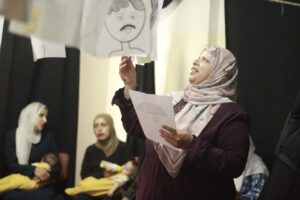
Women participate in Buzoor Theater workshops. Photo by Buzoor (2026).
You mentioned informal support networks among women. Can you describe how women in Gaza support each other?
Under the current conditions, many women in Gaza rely heavily on informal community support networks. The first source of support is often the extended family, including mothers, sisters, and other female relatives, as they are usually the closest people and the most able to provide emotional and psychological support. Women also draw significant support from neighbors, friends, and social networks within their communities, particularly in displacement settings and densely populated areas. They often share information about available assistance, services, and resources, while also providing one another with practical and emotional support in navigating daily challenges. In some cases, women turn to trusted community figures, volunteers, or local women activists who are known within their communities and can help guide them or connect them with organizations and services that may be able to provide appropriate support.
At the same time, it is important to recognize that while these informal networks play a vital role, they cannot replace specialized protection and support services. They help women cope, adapt, and remain resilient, but they are not always equipped to address every situation or provide the professional assistance that some women and girls may require, particularly in cases involving violence, trauma, or complex mental health and psychosocial needs. For this reason, strengthening both community-based support networks and formal protection systems remains essential to ensuring that women and girls have access to the full range of support they may need.
What long-term effects do you foresee on girls growing up in Gaza under these conditions, what do you think of the term “lost generation” that is used lately?
There is no doubt that the conditions girls are experiencing in Gaza today will have long-term effects on their lives. We are talking about years of psychological stress, repeated disruptions to education, the loss of a sense of safety and stability, and the traumatic experiences endured by thousands of families. Still, I am personally cautious about using the term “the lost generation.” The phrase seems to pass judgment on an entire generation, implying failure or hopelessness, and I do not believe it reflects the full reality. What we see on the ground is a generation that has endured extraordinarily difficult circumstances, but one that has also demonstrated remarkable resilience, adaptability, and determination. Many girls continue to hold on to their dreams and aspirations despite the challenges they face. They are still seeking opportunities to learn, express themselves, and contribute to their communities.
The real challenge today is ensuring that this generation is not left to deal with these consequences alone. What is needed is meaningful investment in education, psychosocial support, cultural and artistic activities, and initiatives that empower girls to discover their abilities and make their voices heard. Personally, I prefer to describe them as a generation that has survived and deserves opportunity, rather than a lost generation. Their future will not be determined solely by the circumstances into which they were born, but also by the support, resources, and opportunities made available to them in the years ahead.
You are working with theater and animation as a tool of reflection, coping and healing for women in Gaza. Can you describe your approach?
At Bozour Theatre, we believe that art is not a luxury, especially in times of crisis. Rather, it is a vital tool for expression, resilience, and recovery. Our methodology is based on creating safe spaces where women and girls can share their stories and express their emotions and experiences in ways that respect their dignity and protect their privacy. In theatre, we do not simply ask participants to perform. Instead, we encourage them to transform their experiences, ideas, and questions into stories and creative performances. Theatre helps break isolation, build self-confidence, and foster a sense that their voices are heard, valued, and important.
Animation offers a different but equally powerful means of expression, particularly when addressing sensitive topics or emotions that may be difficult to discuss directly. Through drawing, storytelling, and character creation, participants can communicate their thoughts and experiences in a creative and safe way. Ultimately, the goal is not merely to produce a play or an animated film. It is to empower women and girls to reclaim their voices, express themselves, and build supportive relationships with one another.
Many participants tell us that one of the most valuable outcomes of the process is realizing that they are not alone and that their experiences and feelings matter and deserve to be shared. Through our experience in Gaza, we have witnessed how art and culture can open a window of hope amid extremely difficult circumstances. They help people preserve their sense of humanity, strengthen their resilience, and maintain their ability to dream, create, and move forward despite the challenges they face.
What are the emotional and ethical realities of running a project with women in Gaza today?
Frankly speaking, implementing any project with women in Gaza today is not simply a matter of delivering an activity or running a program, it is a profound human and ethical responsibility. We are working with women who have endured extremely difficult experiences and have lost loved ones, homes, and important parts of their lives. This means that the person must always come before the project, and listening must come before any activity or expected outcome. From a psychological perspective, we strive to be highly sensitive to participants’ realities and individual needs. We do not assume that everyone is ready to speak or engage in the same way. Instead, we create space for each woman to decide how and when she wishes to express herself. Sometimes, the most meaningful achievement is simply providing a place where a woman feels safe, respected, and free from the pressures of daily life. From an ethical perspective, we are committed to ensuring that women’s stories and suffering do not become mere statistics or content to be consumed by others. We place strong emphasis on informed consent, respect for privacy, the protection of participants’ dignity, and ensuring that any participation is entirely voluntary and based on the woman’s own choice. In reality, despite the immense challenges, the women themselves teach us lessons in strength, resilience, and determination every day. Our role is not to speak on their behalf, but to provide the space, tools, and opportunities for them to tell their own stories in their own voices. For us, this is the essence of cultural and community work at this moment: creating conditions in which people can reclaim their agency, express their experiences, and be recognized not only for what they have endured, but also for their strength, creativity, and humanity.
Do you sometimes feel like your approach reaches it’s limits in confronting current realities?
There are many moments when people’s most urgent needs are safety, shelter, food, clean water, and healthcare. No artistic or cultural activity can substitute for these fundamental rights and necessities. Art can create space for expression, connection, reflection, and hope, but it cannot, on its own, remove the conditions that cause suffering. The real limits of our methodology become apparent when people are entirely preoccupied with survival and securing their basic needs, or when the trauma and losses they have experienced exceed what any short-term intervention can realistically address. For this reason, we do not present art as a magic solution. Rather, we see it as one component of a broader response that supports resilience and helps people preserve their voices, dignity, and sense of humanity. Even so, every time I see a woman or girl share her story, regain a measure of self-confidence, or feel genuinely heard after a long period of silence, I am reminded of the value of this work. It may not be able to transform the reality around them on its own, but it can provide people with a space to face that reality with greater dignity, strength, and hope.
In your view, what would a meaningful “rebuilding of Gaza” look like for women – not just physically, but socially?
In my view, the reconstruction of Gaza should not be limited to rebuilding homes, roads, and physical infrastructure, important as those efforts are. True reconstruction must also involve rebuilding people’s lives, restoring social relationships, and creating a renewed sense of safety, dignity, and belonging within communities. For women, any effective reconstruction process must begin by listening to them and ensuring their meaningful participation in planning and decision-making. Women should not be seen solely as beneficiaries of reconstruction efforts; they should be recognized as active partners in shaping them. Women have lived through the realities of war, displacement, and loss, and they possess a deep understanding of the needs and challenges facing families and communities.
It is also essential to invest in education, psychosocial support, and economic opportunities that enable women to regain their independence and strengthen their ability to support themselves and their families. At the same time, there is a need to rebuild community and cultural spaces that bring people together and help restore the social bonds that have been damaged over recent years. From my perspective, the success of reconstruction should not be measured only by the number of buildings rebuilt. It should also be measured by the extent to which people—especially women—are able to regain a sense of dignity, security, and hope for the future. A strong society is not built with bricks and concrete alone; it is built through people, their participation, and their ability to shape their own future.