



Originally published by Rosalux.de https://www.rosalux.de/en/news/id/54904/dispatches-from-gaza-return-us-to-ourselves
The most devastating aspect of this war has not been the destruction of buildings and roads, nor the fact that entire camps and villages have been wiped off the map — but rather the damage to human life. We are no longer the same as we were in the past. We are facing a whole new shattering reality and are trying to adapt to the life and culture of war, which seem to have ingrained themselves deeply into our spirits here in Gaza. The war has had consequences for every possible facet of life — including social, religious, and political dimensions — and nobody has been spared.
Each day is just like the one before. There is never anything new. Mornings roll round again, untethered from their time and function. They dissolve into wasted moments that try in vain to escape time and space, to escape a reality completely shrouded in madness, as if it were Sisyphus’s boulder. But there is no refuge, no escape. Everything is beyond our control. All we can do is wait.
The Ceasefire That Changed Nothing
Yesterday I was talking to a friend who lives in the West Bank. She asked me whether we were following America and Israel’s war against Iran. I said: “We’re still living through the war here in Gaza, my dear, despite reports of a ceasefire. Every day brings destruction and new casualties, not to mention the many others dying of indirect causes. And so many people are haunted by grief. This grey, uncertain state that we are living through might be even harsher than the war itself.”
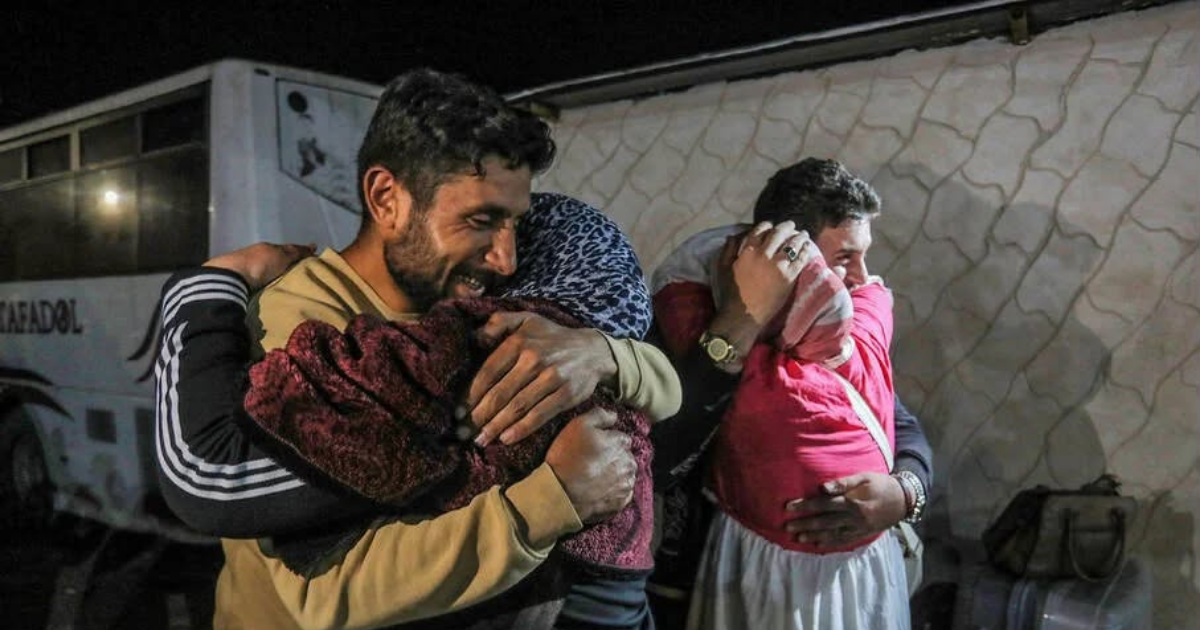
They tell us that the Rafah Crossing is operational. But only 50 people are allowed to enter or exit per day, and under appalling, humiliating conditions. Is this a crossing or a prison gate? A prison gate is probably less humiliating than the Rafah Crossing. Given these facts, can we really say that the crossing has been reopened? The answer is a resounding “no”.
The health sector is in similar straits. After the destruction of all the hospitals in Gaza, the exodus of qualified doctors, the lack of medical supplies, and with only half-destroyed medical facilities remaining — can we really say that we have a functioning health system? The situation is even bleaker than that: someone awaiting a simple surgical procedure might die before receiving treatment, because the crossing only lets a few patients through every day, and only after humiliating searches.
A Child on the Sand, Holding a Broken Pen
As for education, this is the deepest wound in the heart of the new generation. Children as young as nine have not been to school in years: schools have either been destroyed or turned into shelters for the displaced. Sometimes you will find remedial lessons being offered in a dilapidated tent, but this is like putting a plaster on a gaping wound. A child sits on the sandy ground, holding a broken pen, trying to understand mathematics while the tent flaps in the wind. How can they build their future when their present is rife with waiting and fear? The schools are still crammed with thousands of displaced people, and the supplementary lessons offered here and there are just a drop in the ocean. There is no education; the educational sector has been obliterated. Can anybody claim that we have an educational system? Absolutely not. What is left, when over 50 percent of the territory of the Gaza Strip is now under Israeli occupation?
As for the precious resource of water, most of Gaza’s water is now unsafe to drink. We drink it in the knowledge that it might cause illness— but there is no alternative. From time to time we might be able, with enormous difficulty, to find a gallon of potable water. Electricity only comes on for a few hours; otherwise, we light candles or use mobile phones to see each other’s faces in the dark, then we switch them off.
So we have no health system, no educational system, and no basic necessities for life. Under these circumstances, how can we keep up with the war in Iran or anything outside Gaza? We do not even follow our own news; we are completely consumed by our daily struggles. Those who are engulfed in flames cannot focus on anything other than putting out the fire.
The Newly Rich and the Dying Poor
The newly rich, those who have sprung up like mushrooms after rain, control the black market. They sell goods and fuel at exorbitant prices, far beyond the means of the poor. They wait in the shadows, triumphant grins on their faces, while others die of hunger. The vast majority of people wake up every morning and go to bed every evening burdened with the same worry: how will we provide enough food for our children? How will we protect them from the bitter cold or the blazing heat? Some families are yet to receive any aid, despite having lost everything. Others who have been unaffected by the bombardment have received more aid than they need, and have started selling it. The injustice burns us more than the bombs themselves.
This war is a living hell for the poor. I have heard a lot of people wishing for death every day, because they feel unable to provide daily sustenance and for their children’s basic needs. Even the aid that is given out by various agencies and organizations is unfairly distributed. Those who have connections still receive more than their fair share. For example, many families have lost their homes and are still living on the street; they have not been provided with tents to protect their children from the freezing cold or blazing heat. Meanwhile, others who did not even lose their homes receive tents all the time, and have thus begun reselling them. This war is full of crushing injustice, and the poor and vulnerable are its greatest victims, suffering doubly from its impacts.
Waiting for the Sun
There are endless stories, endless tragedies. But we cling to the hope that a political solution will be implemented that will change the reality of life here in Gaza. That an independent Palestinian state will be founded and that peace will prevail throughout the land. Not only has the seawater become murky, but so have the streets, and the general atmosphere. Now even people’s souls need to be purer, clearer. The earth turns on its axis every day, and every day we wait change, but the cycle continues. Everywhere else, night is followed by day, but not in Gaza. In Gaza, night is followed by night. When will all of this darkness end, and the sun of freedom rise? We have waited for this sun for so long, and we continue to pay the price with our lives, and with the lives of our children, our young people, our women, our elders. Our lives have almost come to an end, and still we continue to search for some semblance of a normal human life.
A crossing or a prison gate? Only 50 people are allowed to pass the Rafah Crossing every day. Wounded Palestinians returning to their families from Egypt in April 2026 – IMAGO / Anadolu Agency
No, my friend, we do not follow the war, because I am certain that the war in Gaza is far more brutal and crushing than the war in Iran and Israel. The war in Gaza did not end when the ceasefire was declared. It has turned into a silent war that is eating us up from the inside, day after day, hour after hour. Every morning arrives heavy as a rock. The night has lasted for so long: it has become a companion that never leaves. We wake up to the sound of the wind shaking our tattered tents, or the crying of a hungry child looking for something to fill its stomach. We sleep with images burned onto our retinas of the martyrs who have been killed since the “ceasefire” was declared; or the wounded who are dying slowly because no treatment is available.
In every corner of Gaza, people have endless stories to tell. There is a mother who has lost her husband and her home, and now lives with her five children in a tent that leaks whenever it rains. She says, “A tent is better than living in the street, but it’s not a home”. There is a young man in his twenties who had dreamt of becoming an engineer, but today he is standing in a long queue at an aid distribution point, hoping to receive a bag of flour or a can of tuna. “We were studying at university”, he says, “and now we’re studying how to stay alive”. As for children: if only they could play the way they did before the war. But now they collect stones from under the rubble, or use pieces of charcoal to draw the faces of their dead parents on destroyed walls.
We are drowning in the brutal conditions of our daily lives. We are barely able to keep up with our own news, much less that of a faraway war between Iran and the United States. If you are on fire, you cannot look at someone else’s flames. We are waiting: waiting for a real political solution that will restore our dignity to us, and that will rebuild our homes, schools, and hospitals. Waiting for an independent Palestinian state, where a child can go to a real school, and someone who is sick can be treated without delay, and a family can eat without fearing what the next day will bring.
Hope remains a glimmer that we cling to. Despite the greyness that envelops everything, we believe that the sun will shine someday. It is not only seawater that needs purification, but our souls too. When will the long night of Gaza end and the long-awaited sun of freedom rise? We have paid a heavy price: the blood of our children, the dreams of our young people. But we will not surrender. Life, no matter how harsh it becomes, is resilient. And someday we will be able to return to the way we were — with even more clarity and strength.
Ali Abu Yassin is a theatre director and acting teacher, and lives in the al-Shati refugee camp in Gaza City, one of the largest refugee camps in the Gaza Strip.
[Translated by Wiam El-Tamami and Rowan Coupland for Gegensatz Translation Collective]