



Originally published by Rosalux.de https://www.rosalux.de/en/news/id/54926/gazas-food-sovereignty-crisis
In Gaza, the hungry forage for food while farmers and seed keepers struggle to preserve Palestinian agriculture.
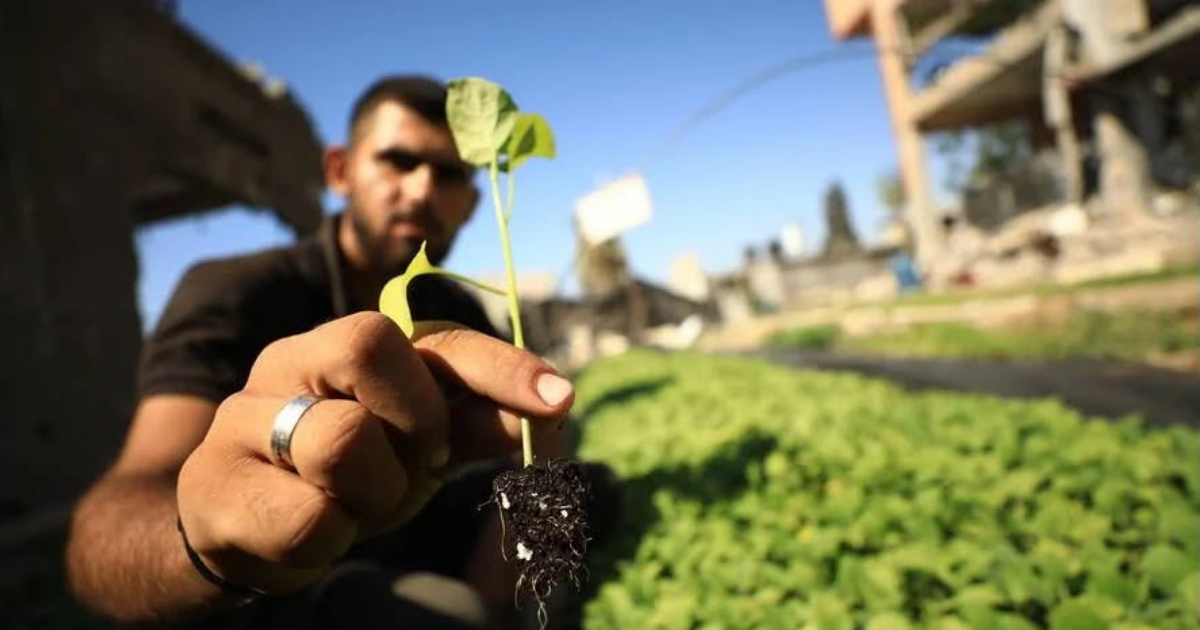
Gaza is experiencing famine, while over 80 percent of its cropland lies damaged or destroyed. But a network of farmers and seed keepers is trying to preserve what remains of Palestinian food sovereignty. After decades of systematic attempts to eliminate specific, localised forms of human knowledge, it has resurfaced in the struggle to survive genocide: Which wild plants are edible in the freezing rain of February; how to stretch flour with foraged herbs; or how to preserve indigenous seed varieties without refrigeration.
In the Gaza Strip, this knowledge was not fundamental to the dominant agricultural model before October 2023. Gaza had a semi-functioning, if severely constrained, food economy, consisting of local markets, commercial farming, and very limited import channels. Food sovereignty practices existed at the margins, like elsewhere, in the work of small organisations like the Gaza Urban and Peri-Urban Agriculture Platform (GUPAP), in the seed-saving habits of older farmers, or in the memory of communities that had already survived the dispossessions of 1948 and 1967.
In 2007, Israel imposed a land, air, and sea blockade, restricting the movement of people, goods, and agricultural inputs. This siege became the operating condition of everything that followed. Major military wars raged in 2008-09, 2012, 2014, 2021, and then the genocide began in 2023. Every war destroyed infrastructure and none of it was fully rebuilt before the next assault. By 2022, Gaza’s poverty rate had reached 65 percent and food insecurity affected over half the population.
As of mid-2025, UN bodies, international legal scholars, and genocide researchers have described what is happening as meeting the legal threshold for genocide, the deliberate destruction of the conditions necessary for a group’s survival. In August 2025, the Famine Review Committee classified the situation in Gaza as IPC Phase 5, the most severe level of famine, with malnutrition-related deaths on the rise. In other words: People are starving to death.
The Destruction of Palestinian Agriculture
The annihilation of Gaza’s agriculture is an important step in the erasure of the local population. According to FAO and UNOSAT data, over 80 percent of Gaza’s cropland – 12,537 hectares out of 15,053 – has been damaged or destroyed. By mid-2025, GUPAP’s own field assessments put the figure at 86 percent, with only 1.5 percent of cropland both accessible and undamaged.
The Israeli army does not only target farmland: agricultural universities, seed storage facilities, gene banks, irrigation networks, greenhouse complexes, and fishing vessels are in the crosshairs; everything required to keep a food system running. The Al-Qarara Seed Bank in Khan Younis, one of Gaza’s most important community seed repositories, was destroyed in December 2023. With it went varieties that cannot be reordered from a supplier. GUPAP’s field assessment in August 2025 confirmed what any farmer could have told you: 88 percent of family farming operations are unable to acquire local seeds. 55 percent of respondents said original varieties had simply disappeared. The seeds are gone. The knowledge of what to do with them is still there, held by the farmers themselves, but without the seeds, the knowledge had nothing to work with.
Food Sovereignty In Times of War
When commercial markets and borders closed because of the genocide, the official humanitarian aid system was paralysed. The humanitarian aid system proved increasingly militarised as access to food became dependent on military control over borders and distribution. Humanitarian agencies were required to coordinate aid deliveries through military approval mechanisms, while border crossings were repeatedly restricted or closed, fuel deliveries were limited, and aid convoys faced delays, denials, and constantly changing routes. According to the United Nations Office for the Coordination of Humanitarian Affairs (OCHA), humanitarian operations in Gaza were constrained by extensive movement restrictions, access denials, and military displacement orders, while by June 2025 approximately 82 percent of the Gaza Strip had been designated either as a militarised zone or placed under displacement orders. For their survival people fell back on what proponents of industrial agriculture had spent decades dismissing: wild foods, collective cooking, decentralised seed networks.
We should be frank about what this means. People died in a man-made famine. Food sovereignty practices did not prevent that. No foraging network or seed-saving circle substitutes for demolished infrastructure destroyed irrigated land, and blocked supply routes. Food sovereignty is genuinely hard to apply under conditions of active genocide. But the question is what kept more people alive in the meantime, and what preserves any possibility of rebuilding a food system once the killing stops. On both counts, the evidence from the ground points toward the women with the seeds, not toward the aid corridors that kept closing.
And this is not a choice between food sovereignty and humanitarian aid. Gaza needs both, without conditions, without the coordination requirements that route emergency relief through the same military enforcing the siege. Emergency aid addresses what is on fire. Food sovereignty is the question of whether, when the fires stop, there is land left, seed left, knowledge left to rebuild from. Framing aid and food sovereignty as rivals is itself a political position, one that serves the siege.
Criminalising Foraging in Palestine
Malva, khobeiza in Arabic, became the plant most associated with surviving the famine. Long dismissed as a weed, gathered in harder times by people who had no other option, it kept families alive in displacement camps across the southern strip. Women gathered it from whatever patches of earth remained, folded it into bread baked over open fires, and passed on the knowledge of how to find it to children who had grown up with grocery stores. But khobeiza was not alone. Palestinian foraging knowledge is wider than any single plant: shomar (fennel), hindbeh (dandelion), hummeid (bitter dock), loof (black calla), halayoon (wild asparagus), more than 100 wild edible species in active traditional use across Palestinian territories, each with its season, each with a preparation that takes years to learn properly and minutes to lose.
This knowledge is doubly political, since colonial law tried to outlaw it for decades In 1977, Israel designated wild za’atar (Majorana syriaca) a protected species, making its harvesting , possession, and sale illegal. Akkoub (Gundelia tournefortii), a spring thistle deeply embedded in Palestinian food culture, was added to the protected species list in 2005. Although framed as environmental protection measures, these regulations were enforced primarily against Palestinian foragers and traders, including in areas of the occupied West Bank under Israeli control, particularly Area C and nature reserves. Between 2010 and 2016, Israeli authorities issued more than 750 fines for the harvesting or possession of za’atar and akkoub. The issue was therefore never only about biodiversity conservation. It was also about regulating Palestinian relationships to land, seasonal practices, and food traditions. Under famine conditions in Gaza, many of the same wild plants that had been criminalised for decades became essential survival foods. What had been treated as an illegal practice became a necessity of life.
Palestinians inspect the destruction after an Israeli strike on the building in the Sabra neighbourhood of Gaza City, 19 March 2025. Photo: IMAGO / APAimages
Seed Preservation in Gaza
Mass displacement does not only move people. It breaks the connection between knowledge and the ground it was built on. A farmer’s understanding of a specific plot, when it floods, where the water sits near the surface, which slope holds moisture three days longer than the field beside it, comes from working the same land year after year. When families are displaced five, six, seven times in a single agricultural season, that knowledge is gone. Sometimes the seeds survive. Knowing where and how and when to plant them often does not. And the seed preservation manual that GUPAP painstakingly produced, step-by-step practices documented under displacement conditions, validated by farmers, checked by agricultural specialists, cannot fully substitute for what is lost when a farmer is separated from their land for the second or third or seventh time.
The forced decentralization of seed preservation in Gaza holds a radical lesson for global food sovereignty movements. Before October 2023, Gaza’s seed banks were centralized, professionally managed and meticulously documented. The Al-Qarara Seed Bank in Khan Younis was one of the better-known examples, a community lending model run by Hanadi Muhanna and her family, in which farmers received small quantities of wheat, barley, and spinach seeds each season and returned the equivalent after harvest, keeping varieties moving between farmers rather than locked in one building. In December 2023, the Israeli army bombed the seed bank.
Consequently, seed preservation became a decentralized, communal act of defiance. Seeds moved into the shadows. They were hidden inside clothing, buried beneath the sand of displacement camps, and passed hand-to-hand along evacuation routes. Women carried ancestral heirloom seeds through military checkpoints the way they carried scarce medicine.
Hanadi Muhanna and her sister Mona did not wait. Displaced to Deir al-Balah, they began rebuilding the network seed by seed and contact by contact, while Muhanna’s father provided technical support to 16 urban family farmers across southern Gaza. When access briefly reopened during the ceasefire, Dr. Mahmoud Al-Ajouz extended support to five additional farmers in Gaza City. There was no institutional mandate for any of this. There was simply the knowledge, the seeds that remained, and the decision to keep both alive.
GUPAP documented and supported this network through its “Seeds of Resilience” initiative, funded by the Rosa-Luxemburg-Stiftung Ramallah office. A participatory mapping study surveyed 29 households and identified 21 urban family farmers for direct support, 93 percent of whom were women and 62 percent displaced. The initiative confirmed the preservation of at least 15 local seed varieties and distributed seed preservation materials, including glass jars for protecting seeds from moisture and contamination, alongside basic agricultural inputs needed for seed cleaning, drying, sorting, storage, and replanting. Because displacement, military restrictions, damaged roads, and fuel shortages made movement across Gaza extremely difficult, materials were distributed through two collection points serving farmers across three governorates. A single distribution point would have been inaccessible to many participants, particularly those repeatedly displaced between Gaza City, Deir al-Balah, and Khan Younis.
The initiative reached only 21 families in a territory of more than two million people. By the time farmers were identified, many had already been displaced. GUPAP’s staff were displaced as well. The project coordinator signed the final report from a shelter in Deir al-Balah that served as both an office and a refuge for displaced families. Farmers moved from one location to another, roads closed without warning, and entire communities were uprooted. Yet seeds, knowledge, and advice continued to circulate. Through a WhatsApp group connecting 21 farmers across Gaza, a small network endured where so much else had been broken. That it exists at all is significant. Supporting women-led initiatives, supporting grassroots seed keepers, and decentralising seed storage are not only technical steps but also survival strategies.
Beyond the Romanticisation of Resilience
Across the Global North there is a version of post-industrial food politics that has made foraging and seed-saving into things you do on weekends. This romanticism is not specifically European, it runs from Berlin to Brooklyn, Copenhagen to Melbourne, and wherever it lands it carries the same assumption: that these practices are chosen, that the people doing them are moving forward rather than being pushed back.
What is happening in Gaza makes that assumption untenable. Gathering wild plants because your farmland has been bombed is not a food movement. Storing seeds in glass jars under a tent because the seed bank was destroyed is not an alternative agricultural model. Calling these things indicators of a desirable future is a way of consuming suffering as inspiration, and the people providing inspiration for these movements do not benefit from the transaction.
Didier Fassin has written that humanitarian systems manage suffering without disturbing the arrangements that produce it. In Gaza these arrangements are not an abstraction, they are reflected in the aid convoy negotiating access with the military enforcing the siege, the caloric minimum calculated without reference to whether anyone can cook, the reconstruction funding conditioned on political compliance. Food sovereignty does not fit inside that logic because it refuses the premise. Food sovereignty is not asking for dependency to be managed better. It is asking for the end of the conditions that create dependency.
Food sovereignty ultimately depends on more than seeds. It requires access to land, control over water, and the political ability of communities to decide what happens to the ecosystems on which they depend. The 21 families preserving seeds in Deir al-Balah, Khan Younis, and Gaza City are not symbols of resilience for others to celebrate. They are farmers trying to protect the biological foundations of a future while the conditions that make farming possible are being systematically destroyed. Their survival should not be romanticised. It should force us to confront the political structures that made such survival necessary in the first place.
Raya Ziada is Programme Manager for Food Sovereignty at Rosa Luxemburg Stiftung’s Regional Office in Palestine and Jordan. She is co-founder of the Manjala Agricultural Initiative and a founding member of the Palestinian Agro-Ecological Forum. Her work focuses on food sovereignty, agroecology, and decolonial political ecology.