



This interview originally published at rosalux.de
Raya Ziada: Every October, Palestinian families in the occupied West Bank go out to pick their olives. This season, attacks by Israeli settlers linked to the harvest have – according to the UN – already passed the total for all of 2025. The season officially opens now. According to the latest figures, Israeli settlers and soldiers carried out 377 attacks on Palestinians across the West Bank in just two weeks.[1] What does a harvest day look like this year?
Saad Dagher: The night before, families prepare what they will take: food, water, mats to catch the olives. In the morning they set out together and eat breakfast among the trees. They light a fire with the branches they have pruned and make tea with sage picked from the land. There is qalayet bandora, fried tomatoes, and bread from the taboon, the clay oven. The harvest has always been a gathering, a way for a community to hold itself together. But today people leave home not knowing what they will find. Many go believing their trees may already have been cut down. And they fear attacks by the Israeli army. I stress the army. As for the settlers, they do three things. They attack farmers while they are picking. They burn the trees, or pick the olives for themselves. And they seize the olives families have already picked and bagged. For two years now there has also been a new practice: settlers and soldiers throw incendiary devices into the hollow of a trunk, so that the tree burns from the inside and cannot be put out. Recently settlers opened their own olive press near Deir Ballut, west of Salfit in the northern West Bank, where they press the stolen olives.
You stress the Israeli army rather than the settlers. Why?
Because the army is the occupation’s main tool. It makes the settlers’ theft easier, it attacks, and it protects them. The settlers are part of the army’s effort: organized, armed, and trained to repress, to beat and to smash. In recent days Israeli settlers attacked a group of farmers in a small village in Salfit governorate, under the army’s protection. Some were beaten with iron bars and badly injured in the head. Elsewhere, farmers went out to pick, and the next day Israeli soldiers came and told them to leave immediately or be arrested or beaten. People now gather in groups to protect one another. We have seen calls on settlers’ social media pages to attack farmers.
Who decides when the harvest begins, and how has that changed?
It used to be the villages. Agricultural committees, together with the mukhtars (village heads) and family councils, set the date region by region, and everyone kept to it. The right time depends on altitude, on whether you are in the north, the south or the west, and on whether the first or second rain has fallen. Our baladi, the local olive, reaches 27 to 34 per cent oil only six full months after the fruit sets. Then the calendar shifted. When Palestinian farmers began working in the Israeli labor market, the harvest was timed to the Jewish holidays in September and October, when they were given leave. For about ten years now, the Palestinian Ministry of Agriculture has announced one start date for everyone, around 10 or 15 October. An olive picked before it is ripe gives much less oil, so a single date means many farmers pick too early and lose oil. The ministry could announce the start and stagger it: say, 10 October in the west, 17 October on the high ground around Ramallah, 20 October around Salfit. Instead people race each other, and now many pick even earlier, because they fear the settlers will steal their olives or burn their trees first. I call it chaos.
The Oslo Accords of the 1990s divided the West Bank into three zones: Area A, run by the Palestinian Authority; Area B, where Palestinians manage civil affairs and Israel controls security; and Area C, around 60 per cent of the territory, under full Israeli control. Farmers whose land lies near Israeli settlements – illegal under international law – or behind Israel’s separation wall need Israeli permits, or “prior coordination”, to reach it. How does that system work?
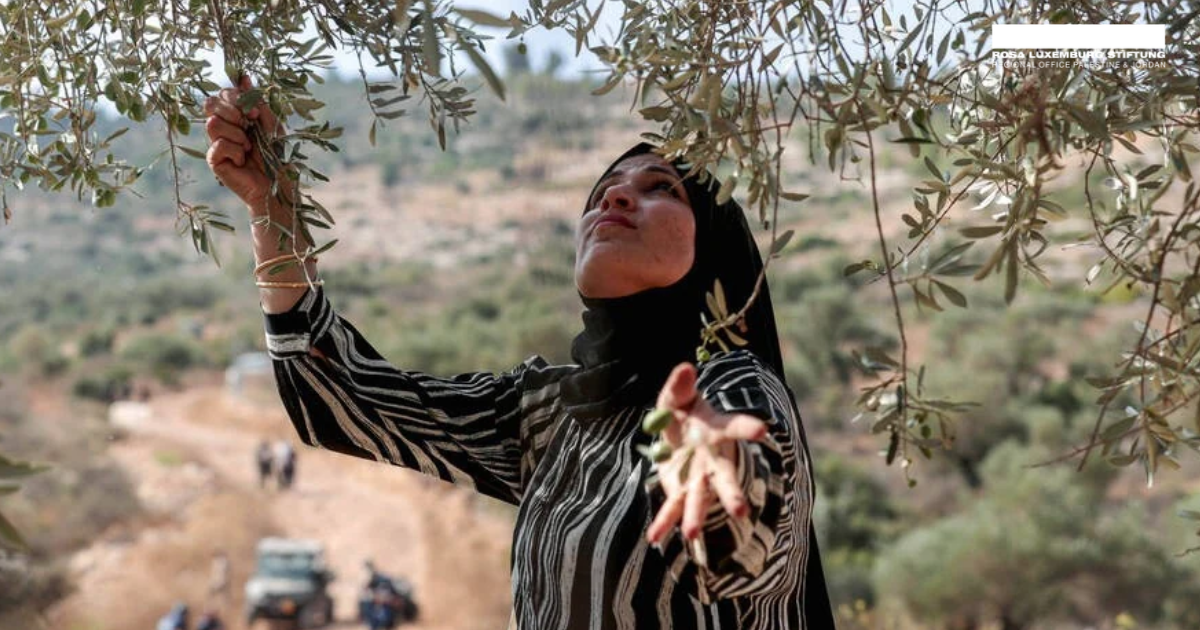
A woman harvesting olives in the town of Deir Ibzi, near Ramallah in the West Bank on 9 October 2026. Shortly after, clashes broke out between Israeli settlers, accompanied by Israeli soldiers, and Palestinian farmers. Anadolu Agency
Under Oslo, “security coordination” and the military and civil liaison offices decide when owners may reach that land. They call it organization. In fact it is the occupation controlling when people may enter their own land. Since the apartheid wall went up, this control has become a way of keeping Palestinians out. Today Area C is under the same control as the land behind the wall. The permits are for the harvest, a few weeks a year. For the rest of the year, the owners are shut out.
UN monitoring of the wall’s northern section found that most of its agricultural gates opened only for the olive season, about 45 days a year.[2] What does that do to the land?
Land that you reach for a month a year is land you work for a month and leave for the rest. And land left unworked for three or four years is in danger: that is how it is taken. So our answer has to be the opposite of their calendar. We must restore the idea that the land is a complete unit of production, not a single crop, and that it can produce all year round. On the spiritual level, the olive tree needs us to bring back the love we once had for it. It is not enough to sing its praises. On the technical level, it needs company: people, and plants too. Our grandparents planted almonds, grapes and figs among the olives. The tree needs pruning, natural fertilizer and soil left covered, without ploughing. Take ten dunams, a hectare. Five go to winter crops: onions, garlic, wheat and lentils, planted from October and tended until May. The other five go to summer crops: tomatoes, okra and molokhia, planted in February or March and harvested from May into October. The next year the plots swap. There is work on the land all year, an income, and, organized well, a large share of a household’s food, and then a village’s. And it is political: by staying on the land and working it, I protect it, and I show that I am here despite the occupation. A permit gives us the land for one season. Farming it all year is how we refuse that.
In Abwein, a village north of Ramallah, the municipality has formed a team of young men to accompany pickers after settlers stole olives there. How can villages protect themselves?
Collective work is the beginning. When people work together, production rises, there is some protection, and our ability to face the settlers and the army grows. Plots come together, and the land is worked as one again.
Since the start of the year, more than 55,000 trees, most of them olives, have been damaged, according to the Palestinian Colonization and Wall Resistance Commission.[3] How do you read these figures?
On 12 October 2023, five days after the war on Gaza began, I recorded a video and said that what was coming to the West Bank would be more dangerous than what was happening in Gaza. We are only at the beginning. This is extermination, and the 30 Palestinians killed by settlers in recent months are only part of it. It means wiping out Palestinian existence: livelihoods, shelter, homes. Bezalel Smotrich, the Israeli finance minister, issues orders to demolish buildings in Area A, where Israel has no planning authority, and homes are demolished in Area B too. It includes ecocide, which aims to make it impossible for us to stay on this land by destroying our ability to farm it. A people that can no longer produce, and no longer controls its water and its land, has lost its sovereignty. And a tree of two or three thousand years carries the memory of three generations. I remember the branches I climbed when I was seven, when I was ten. When such a tree is destroyed in a moment, no young tree can replace it. Still, we carry on, and we create ways to stay on the land.
In addition to the attacks by settlers and soldiers, what other challenges do olive farmers face?
The occupation comes first. But we also changed ourselves. For centuries we spoke of the olive tree as sacred; in the last three or four decades that feeling has faded. Thousands still care for their trees, but neglect spread. Once jobs in Israel opened up, farming came to be seen as low-value work, and farm income looked like nothing next to a wage there. We lost cooperation and the exchange of produce: I give you cotton, you give me a rotl of wheat, or ten kilos of oil for wheat. We became more individualistic, and land was neglected across wide areas. Even our own Palestinian laws forget the countryside. They treat a village as if it were a city: one law bans keeping animals in residential areas. And the worst thing I can imagine is a farmer buying a packet of milk in a supermarket.
Much of the support for Palestinian farmers comes from international donors. How do you see that aid?
I am not against giving a farmer a saw. I speak as head of a council of some 600 families, about 150 of whom cannot afford nappies or medicine for diabetes and blood pressure. But today everyone hands out ten kilos of tomatoes and calls it strengthening steadfastness (sumud). It is not. Real support means building up collective work and restoring the value of farming, from the home to the university. Producing our own food is now not only a necessity but the priority of priorities, if we are to remain steadfast here. We have nothing but this land, this soil and each other.
In 2024 the International Court of Justice found Israel’s continued presence in the occupied Palestinian territory unlawful and said other states must not help maintain it. What do you expect from people in Germany and elsewhere in Europe?
In the West, many people are afraid of being accused of antisemitism. That fear limits what they dare to say, and regulations limit what they can do, so solidarity with Palestinians is restricted at the moment it is most needed, after the genocide in Gaza. I am not saying anyone should abandon their own causes. But each person must choose a role and not stay silent about injustice, because it will reach them too. People must free themselves from this fear and keep coming here. The presence of internationals in our villages and on our farms, especially during the harvest, matters. The Palestinian cause is not only a Palestinian cause. It is a cause of justice and human dignity, and that makes it an international one. Apartheid in South Africa fell after popular boycotts and demonstrations in Europe put pressure on governments. Boycotting settlement products is not enough. We need a boycott on every level: economic, scientific, political, social and sporting.
And the Arab world?
Governments are one thing. I am speaking about the peoples, from Egypt, Syria, Lebanon and Jordan all the way to Iraq. They will face the same injustice we face, so they have to take their role, even in the darkest times. The occupation has tried everything against us, and we still have the determination and the faith that we will stay.
What would a good harvest look like next October?
First, that there is a harvest at all. Second, that whole families are back on the land, as in the past: picking, cooking, making tea. The harvest used to be a festival. Families helped one another and took turns working each other’s olives, fruit and vegetables. That is where our farming songs came from, and the dabke, our folk dance. Our identity as farmers, and much of our culture, grew out of this work. It saddens me that we now see Israeli settlers doing the same things. They post images of themselves picking olives and pressing oil, as if these traditions were theirs. They imitate our practices in order to erase them.[4] This is not nostalgia. We are not going back to the past to stay there. We hold on to the values of these practices because, under systematic violence from settlers and soldiers, they are tools of resistance: they are how we stay on our land. Sovereignty begins with our connection to the land and the soil. That is why, for us as Palestinians, food sovereignty comes first.
The interview was conducted on 13 October 2026.
Saad Dagher is a farmer and agronomist with a master’s degree in agricultural sciences. He heads the council of Mazari an-Nubani, a village north of Ramallah, in the central West Bank.
Raya Ziada is program manager for food sovereignty at the Rosa Luxemburg Stiftung’s Regional Office Palestine and Jordan.
[1] Figures for the two weeks to October 10, documented by the Israeli rights group Yesh Din, reported in Xinhua, “377 Settler, Soldier Attacks on West Bank Palestinians in 2 Weeks: Israeli Rights Group,” The Star, October 13, 2026, accessed October 18, 2026, https://www.thestar.com.my/news/world/2026/10/13/377-settler-soldier-attacks-on-west-bank-palestinians-in-2-weeks-israeli-rights-group.
[2] In 2013, 63 of the 81 agricultural gates monitored opened only during the olive season, a period of about 45 days. UN Office for the Coordination of Humanitarian Affairs, “Approaching the Tenth Anniversary of the ICJ Advisory Opinion: Impact of the Barrier on Agricultural Productivity in the Northern West Bank,” March 20, 2014, accessed October 18, 2026, https://ochaopt.org/content/approaching-tenth-anniversary-icj-advisory-opinion-impact-barrier-agricultural-0.
[3] Mahmoud Abu Obaya, “موسم الزيتون 2026.. ترتيبات ميدانية لحماية المزارعين والوصول إلى أراضيهم” [The 2026 olive season: field arrangements to protect farmers and reach their land], WAFA, October 4, 2026, accessed October 18, 2026, https://www.wafa.ps/news/155225.
[4] Israeli settler farms have posted videos of their own olive picking and pressing, including oil sold as “Pure Olive Oil” from groves Palestinian owners cannot reach. Nida Ibrahim, “Israeli Settlers Take Palestinian Olives, and Their Harvest Traditions,” Al Jazeera, October 8, 2026, accessed October 18, 2026, https://www.aljazeera.com/features/2026/10/8/israeli-settlers-take-palestinian-olives-and-their-harvest-traditions.