


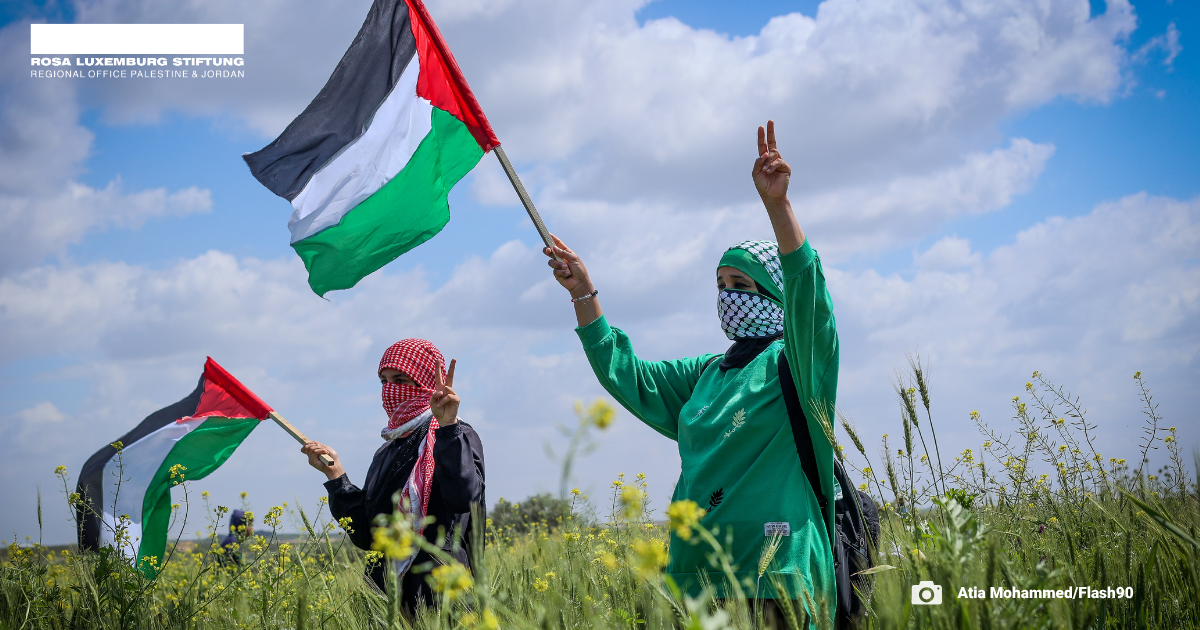

On 30th of March 2026 Palestinians commemorate the 50th anniversary of “Land Day”, where in 1976 Israeli forces killed six Palestinian citizens of Israel during marches and a general strike opposing the seizure of over 6,000 dunams of Palestinian-owned land in the Galilee region inside of Israel. Since then 30th of March became a day to renew Palestinian refusal to Israel’s ongoing land confiscation and to embrace their connection to their homeland.
On this occasion Sari Harb, programme manager at the Rosa Luxemburg Stiftung’s Palestine and Jordan Office, had a short conversation with Palestinian citizen of Israel, Reem Amr, a colleague from the Rosa Luxemburg Stiftung Office in Tel Aviv, who was born in Kafr Qasim. Kafr Qasim, today a Palestinian town in central Israel and part of the “Triangle” region, was one of the Palestinian villages that participated actively in the demonstrations at that time. We spoke with her to reflect on the meaning of “Land Day” and its significance today.
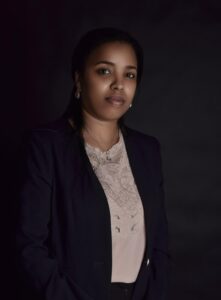
Reem Amr, Palestinian citizen of Israel, and a colleague from the Rosa Luxemburg Stiftung Office in Tel Aviv, who was born in Kafr Qasim. Kafr Qasim, today a Palestinian town in central Israel and part of the “Triangle” region, was one of the Palestinian villages that participated actively in the demonstrations at that time.
Looking back, how did you experience “Land Day” in the past? What stands out most in your memory?
For Palestinian citizens of Israel, “Land Day” is a pivotal moment in the national struggle. I was four years old at the time; however, having been born in Kafr Qasim, the site of a massacre in 1956, where 49 Palestinian civilians had been killed by Israeli border guards, including my paternal grandmother, political activism was ingrained in my upbringing. My father, Muhammad Khamis Amer, nicknamed “Patrice Lumumba” after the Congolese revolutionary, was one of the first local politicians in Kafr Qasim. It was only natural that a day of struggle like “Land Day” would be deeply rooted in the political culture of my home.
During my early school years, student movements played a crucial role in my town. Most of their members were affiliated with or supported the Communist Party, as the party served as the primary incubator for political activism.
My first real encounter with the issue of land confiscation within Israel came in the 1980s, when I was in middle school. At the time, there was an attempt to confiscate land near the only high school in Kafr Qasim, and residents and students mobilized to defend it. Several arrests were made.
How is “Land Day” commemorated in Kafr Qasim today?
Over time, “Land Day” became a day of remembrance, marked by a central demonstration called for by the “Higher Follow-Up Committee for Palestinian Citizens of Israel”, a non-parliamentary umbrella organization representing Palestinian citizens of Israel. It can be said that this commemoration has lost some of its revolutionary fervor, despite the continued suffering of Palestinian towns in Israel due to a shortage of land for construction and expansion. This shortage has created a housing crisis for young couples, while land and resources are increasingly allocated to Jewish towns in the Galilee, the Triangle, and the Negev.
This situation has contributed to additional social crises stemming from systemic discrimination, most notably a recent surge in organized crime, which has become a daily reality since the year 2000, and has claimed between 2,500 and 3,000 lives.
In Kafr Qasim, as in other Palestinian towns, “Land Day” has largely become symbolic. Political activists participate in the central demonstration organized by the “Follow-Up Committee”, while many residents, like Palestinians elsewhere, are preoccupied with the daily struggle for survival.
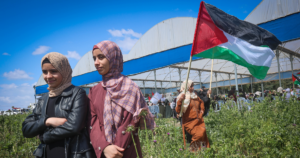
Palestinians protest marking the anniversary of Land Day on the border with Israel, east of Gaza City, March 30, 2023. Photo by Atia Mohammed/Flash90
To what extent is “Land Day” important for Palestinians in different geographies?
Despite local and regional political developments, land, and the struggle over it, remains the core issue for Palestinians, as it is central to their survival. This struggle directly confronts Israel’s expansionist policies and its continued appropriation of land for settlement.
The differing conditions faced by Palestinians across regions further underscore this importance. In the West Bank, Palestinians face settler encroachment, daily attacks on land and people, and ongoing attempts at forced displacement, particularly in the southern Hebron Hills and the Jordan Valley in Area C of the West Bank. Area C, the biggest part of the occupied West Bank, is a Palestinian area under full Israeli civil and military control according to the Oslo Accords in the 1990s. These challenges are compounded by policies of de facto annexation that expand Israeli control, including Area A – under full Palestinian Authority’s civil and security control – and Area B, territories under Palestinian civil control with Israeli security control.
In Gaza, the historic struggle for the right of return has evolved into an immediate struggle for survival amid forced displacement, widespread destruction, and the shrinking of available land.
Among Palestinian citizens of Israel, the struggle for land persists, intensified by an ongoing housing crisis affecting younger generations. This is especially evident in the unrecognized villages of the Negev, which remain under constant threat of displacement due to state expansion policies.
In this context, land continues to be the central axis of Palestinian existence and survival, wherever Palestinians reside.