



Since the beginning of the war on Iran, Gaza has disappeared from news broadcasts, both in Arab and international media. Everything related to Gaza has suddenly gone quiet, as though the light that was being shone on the tragedy was suddenly switched off. Demonstrations in solidarity with Gaza have ceased; even the boats of the Global Sumud Flotilla are waiting in their harbours, and efforts to break the siege have been postponed indefinitely.
We are no longer following the summits or the delegations shuttling back and forth between the world’s capitals, as though holding numerous meetings was the key to Gaza’s salvation. The people of Gaza have always made fun of these meetings, knowing that they are all a smokescreen, and that nothing has ever come of them. We are still experiencing the same forms of suffering as our grandparents: history is systematically, viciously repeating itself. It is as though the world’s collective imagination cannot accommodate more than one victim at a time.
During the war, hundreds of political analysts would appear on Arab and international screens, following and dissecting every detail (pontificating, in many cases, without knowledge or evidence). The news from Gaza was being followed by the entire world — except in Gaza itself, that is, where electricity was completely cut off and no fuel remained to power televisions. Since the beginning of the war, there have been constant issues with telecommunications and the internet. And even if we could watch the news, the people of Gaza have grown sick and tired of the lies, hypocrisy, agendas, and vested interests that have filled the airwaves and drowned out any remaining semblance of truth.
Sometimes we hear reports that there is a technocratic committee running Gaza, headed by Nickolay Mladenov, who is in turn being controlled by Trump — and many believe that Netanyahu is controlling Trump. This brings us back to a perplexing question: who is controlling whom? Is Israel controlling the United States, or the United States controlling Israel? Which came first, the chicken or the egg? In this labyrinth of tangled policies and conflicting interests, the people of Gaza have been completely passed over: when it comes to decision-making, we are never consulted, never involved, despite the fact that the land is ours, and we are the ones who have suffered the most.
Ultimately, is Gaza now the remit of US president Donald Trump, head of the Board of Peace? Is the occupation now in charge of Gaza? Or is Hamas still controlling what remains of the territory? But the bigger question is: where is Gaza? Where are its topographical features? Where are its buildings? Where are its people? Where is its sea, its air? Its hopes, its dreams — its future? It seems to have drowned in the sea, and resuscitating it will take many years. We, the people of Gaza, are now utterly lost, like a ship adrift at sea, tossed about by the waves. We are trying, in vain, to find our way back to shore — but the waves are high and the winds are fierce.
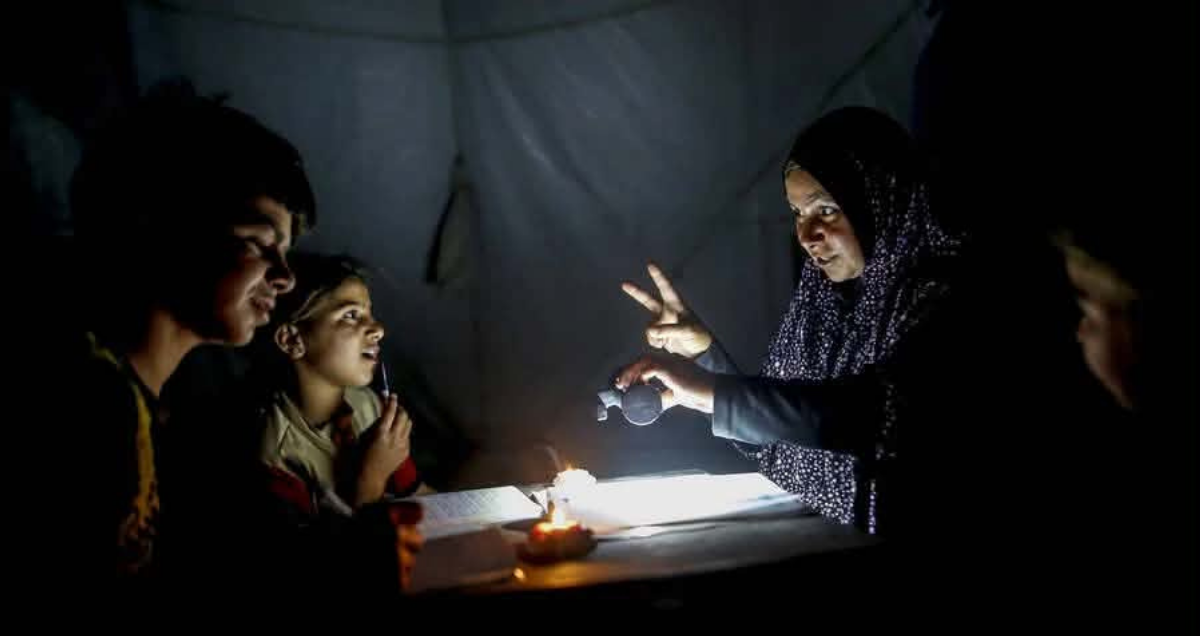
Our children are still in tents, shivering in the cold, and many of them have frozen to death while the eyes of the world are on Iran. Starvation has crept in under cover of night: people are quietly anticipating another famine. It seems that people have even become accustomed to anguish: we have become numb to things that, in the past, would have caused us to scream out loud. We have no capacity to follow the news of the war on Iran: we have enormous burdens of our own, needs that we have to meet every day. The vast majority of Gaza’s inhabitants go to bed each night and wake up every morning worrying about finding enough food, drinking water, and saltwater to wash with.
Why has the world abandoned us? We spend our days looking for a bottle of medicine for a boy who coughs all night long, or something to bring down the temperature of a little girl whose high fever could kill her. There are no schools, no hospitals; nothing in Gaza is being resolved. All too often, the facts are distorted to serve war profiteers, who are always ready to trade in anything and everything, to build their fortunes on the piles of corpses and the wails of mothers.
Dear world — dear brothers and sisters, dear comrades — we are here. The cold is still gnawing at our bones. We are still dreaming of safety, of peace, of a day when the noise of drones will disappear. We still live in hope that the Rafah Crossing will one day truly open up, and that we will be able to travel to Egypt — and not just as patients on the Red Cross lists, carried there by ambulance and subjected to border searches by everyone under the sun — by Israelis, Europeans, Egyptians, Palestinians, and Filipinos — as though we were a cancer or a plague. We are normal people, and we dream of travelling to Egypt as tourists, as human beings, in order to rest a little and recover some of the humanity we have lost after our buildings have been turned to rubble, after enduring the canvas of these tents, the donkeys pulling carts, and the lentils we have eaten so much of that our blood has turned yellow.
It is our right to pack a small bag and to head to the crossing, and to be let through after a process that lasts for half an hour, or an hour at the most. To travel outside Gaza, to any country in the world, in order to rest and recharge our batteries a little, before returning to this endless oppression and suffering. We despise war, death, and destruction. We have even come to hate the colour red after having seen so much of it, after all the blood our hands have touched.
I often find myself thinking about our children and the future that awaits them. When I do, my mind goes blank. I can honestly say that I see no light at the end of the tunnel; all the facts and indicators point towards more violence and oppression. Violence begets violence, and oppression begets oppression. But I must admit that one of the things that shored up our resolve in Gaza was the solidarity protests that were taking place all over the world throughout the war, especially in Europe. We felt that we were not alone.
Since the beginning of the war on Iran, we feel suspended between sky and earth. We have no idea if we are about to fall into a bottomless pit or to rise up into the air, to a destination unknown. Everything that has happened in Gaza has rendered language meaningless; we have had to search out new terms and imagery to even begin to convey the new reality inflicted on us.
The nights pass, one after the other, in a darkness without end. Every day, we live through the same day, like a film reel playing on a loop. The same scenes every day, and almost the same thoughts, the same faces, the same tent and streets and fear, the same news. Truth be told, I have never been very interested in the news, because I know it is presented according to the whims and policies of the government broadcasting them, and of the leader or president who is in power at the time. The news is usually a bunch of lies interspersed with some moments of truth; they are, as the saying goes: “words of truth intended to deceive”. Meaning can always be distorted by swapping one word for another or even individual letters; shifting the perspective on an image can completely alter the message.
This is why I have never been very interested in the news. But the question remains: why has the world suddenly gone silent about Gaza? While the war in Iran may have taken the limelight, the war is still raging in Gaza, and there are new casualties every day. Just yesterday, five people were killed, all of them young. Their blood is still fresh, still pouring like a waterfall through every alley, every street.
As I was writing this piece, a two-week ceasefire between the United States and Iran was declared. The conversation shifted back somewhat to Gaza and to the disarmament of Hamas, which Hamas has rejected. It is as though Gaza is always in need of an external event to bring it back to the forefront — not because it really deserves attention, but because it is serving some agenda in that moment. This is Gaza’s bitter fate: being a pawn in the hands of others, rather than an independent humanitarian cause that is fought for in its own right.
As I write these words, I wonder how many people around the world are now sitting on a warm sofa, calmly eating their dinner, scrolling through the news on their phone, then putting their phone aside and drifting off into a peaceful sleep. I do not envy them; I just wish we were also that fortunate. I wish that our children’s biggest worries were an upcoming exam or the score of a football match — not the roar of a plane as it passes over our tent at midnight, jolting us from our sleep, our hearts in our mouths.
We did not choose this reality. We did not vote for it. We did not sign any paper saying that we accept this life. It was inflicted on us; fate is always imposed. The difference, though, is that this fate was created by human hands, human decisions, and human interests. And what is created by humans can also be changed by them, if they wish.
Sometimes I sit with my neighbours from the tent next to ours. We talk about simple things: how we have forgotten the taste of coffee; how the smell of the sea seems far away now, even though it is still close. We talk about how we once walked around our streets at night without fear. Sometimes we laugh, a faint laugh that can barely believe that it has come out of this place and time. That laugh is the last remaining semblance we have of a normal life; we guard it as fiercely as one would guard the last lump of coal on a cold night. And as long as that piece of coal keeps burning, then we are still here, still resisting, still human.
Sometimes I wonder: does the world know that the people of Gaza have not stopped dreaming, in spite of everything? Yes, we dream. We dream of the sound of rain on the roof of a real house, not the leaking canvas of a cold tent. We dream that our children will go to school and come back with notebooks full of homework, rather than living through day after day of fear and emptiness. We dream of a warm meal at a full family table, with nobody missing. Very simple dreams that, in Gaza, have come to seem nearly impossible. And still we do not stop dreaming, because the day we stop dreaming is the day we really die, before our souls have even left our bodies.
Ultimately, Gaza is not just a news item that comes and goes whenever there is a new crisis to fill the screens. Gaza is people. Gaza is children dreaming of real houses instead of tents, of schools instead of rubble, and of a future befitting their dreams. Gaza is a mother who kisses her children every night not knowing whether she will wake up to the sound of their voices, or to wails of grief for the missing. Gaza is a father who goes out every day, not seeking success or fortune, but just a loaf of bread, a bottle of water, a pill.
The world, which moves according to its own interests, and points its compass towards more exciting crises, should know that staying silent on Gaza is not neutrality — it is very much a position in itself. Each day of silence means one more day of hunger, of cold, of blood. Every round of talks that is held and concluded without results is another bullet fired from afar into the heart of this steadfast city.
We in Gaza are not asking for pity; we are demanding justice. We are not asking for tears; we are demanding action. We are not asking the world to remember us whenever this suits its agenda, but rather to remember us because we are human beings who have a right to life, to dignity, and to build a future on this land — a land from which we want nothing, other than for it to remain our homeland.
Translated by Wiam El-Tamami and Rowan Coupland for Gegensatz Translation Collective.