



Originally published on Rosalux.de https://www.rosalux.de/en/news/id/54822/dispatches-from-gaza-murder-after-death
Palestinian writer Ali Abu Yassin on the exhumation of Palestinian graves — and what it means to be killed twice.
Since the beginning of the war, I have written many articles about almost every aspect of it: famine, displacement, death, sacrifice, exploitation, occupation, women, children, young people, men, dreams, and hopes. Sometimes I would start working on a new idea, then leave it for a day or two to simmer. But for the past two weeks, I have been tossing and turning over this piece, as though the words were hot coals. I didn’t know where to begin, and yet I was unable to set it aside. It’s a subject that has been explored and debated for thousands of years in various literary and artistic forms. It has been discussed, for example, in Sophocles’s Antigone, written in 441 BCE, as well as in its 1944 adaptation by the French playwright Jean Anouilh. The play explores the theme of the tyrannical ruler through the conflict between King Creon and Antigone, a woman who defies the king’s decree not to bury her brother Polynices. In Creon’s view, Polynices does not deserve to be treated with dignity or to be given a proper burial.
When Sophocles Foretold Gaza
The same situation is now recurring in Gaza. While the Israeli occupation army was searching Shuja‘iya Cemetery for the body of Ran Gvili, the last soldier to have been held hostage in Gaza, they exhumed and removed almost 600 bodies. And that is not all: the search was accompanied by raids and bombing that resulted in over 16 casualties. I was deeply affected by these events, especially since they were not given much coverage in Palestinian, Arab, or international media. It felt as though it is not just our lives that are considered cheap, but our deaths as well. Death alone is not enough, grief alone is not enough — we have to die multiple deaths, grieve thousands of times, and live through endless cycles of loss. To silently swallow all this bitterness and anguish, and not voice a single objection.
Yes, silently: that is exactly how it unfolded. I felt this silence, as though the whole Palestinian situation had descended into such a state of absurdity, insanity, and hatred inflicted upon us — and upon the entire world — by the Israeli occupation. Our death, the complete decimation of Gaza, and all of the blood that has been spilled was not enough to sate its hatred, to quench its thirst for vengeance. I felt that the echo of Antigone’s cry in the face of King Creon, over 2000 years ago, was still ringing today — as though Sophocles had foretold what would happen in Gaza. That history was repeating itself in increasingly bitter and brutal ways
The Shuja’iya Cemetery
When 600 bodies were exhumed and removed from their graves, I felt that the conflict had shifted. It was no longer a conflict between the living, but now encompassed the corpses of the dead in the “afterlife”. Has this insane conflict between us and the Israelis become a fate that chases even the dead? It is as though the body of Ran Gvili is worth all the bodies in the Shuja‘iya Cemetery — or perhaps even more than the bodies of the entire Palestinian population, living and dead.
In the world of fortune tellers and the occult, there is a myth concerning the summoning of spirits of the dead. I found myself wishing that I could summon the spirit of Sophocles to help me write a new piece that could convey this boundless madness, the cruelty of human beings towards their fellow humans, the utter collapse of all human values, principles, customs, and morals. I cannot imagine a soldier exhuming a grave in which a small child lies, perhaps a child who had lost an arm or a foot when the Israeli army bombed his home. Perhaps this grave was his mother’s last remaining haven, the place where she goes to feel the presence of her only son’s spirit, to call out to him as a way of alleviating even a modicum of her pain.
Sometimes I feel that the grief trapped in the hearts of these mothers who have lost their only children is about to burst out of their chests, suffocated by sheer anguish. If this grief had a tongue, I imagine it crying out: “I can’t bear all of this pain any longer!”
In all of the Abrahamic religions, it is said that the dead must be honoured through burial. Since we all believe in the same God, how can we disobey Him by humiliating the dead and killing them twice like this?
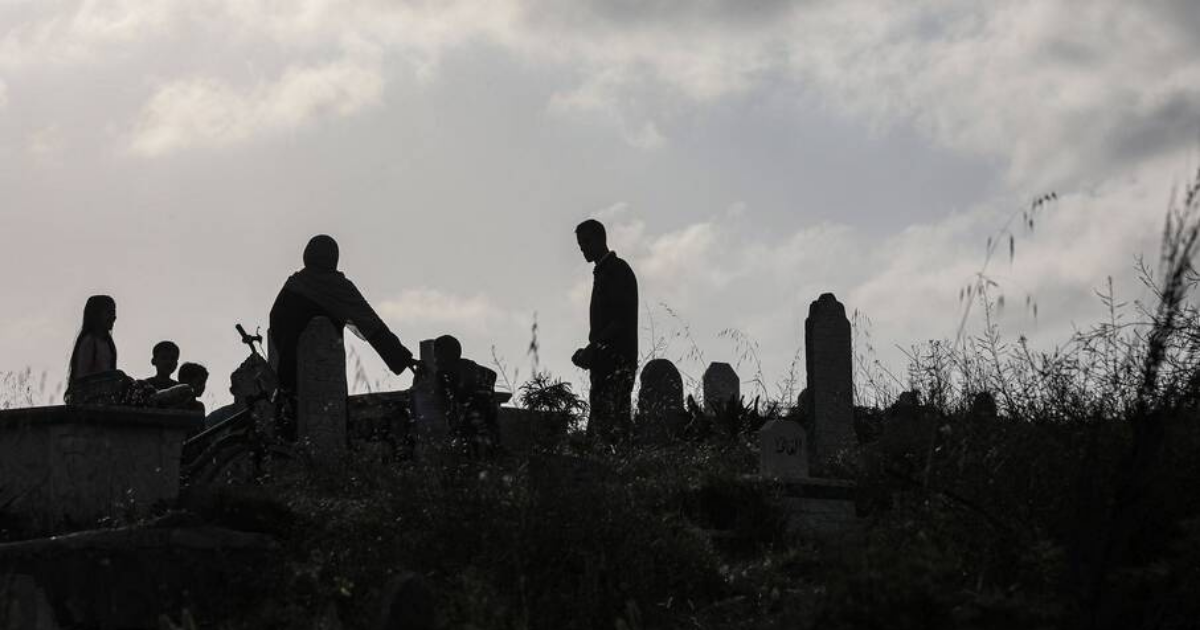
The story did not end there. It also impacted me personally. The day after I returned from the south after our last displacement, I went to the nearby Sheikh Radwan Cemetery, where some of my family members were buried. When I got to where the graves of my mother and brother had lain, I could not find them. The graves located in the northeast section of the cemetery were all gone, and the whole area had been reduced to a vast wasteland of sand dunes and rubble. The entire northern wall of the cemetery had been bulldozed, along with most of the graves, and everything along the cemetery’s perimeter.
Survivors visit the graves of their loved ones at the Sheikh Radwan Cemetery in Gaza City on March 30, 2025, Photo: picture alliance / SIPA | Omar Ashtawy apaimages
A Mountain of Sand Where Their Graves Once Were
On my way to the cemetery, there were huge craters all along the road, left behind by the missiles of the occupation army, with corpses scattered all around. I thought to myself how Palestinians are being hunted down when they are on the earth, and even when they are beneath it. As I came closer to the place where my mother and my brother had been buried, I kept roaming the area, searching for their graves like a raging lion. I was shocked; I could not believe what I was seeing. All that was left were a few remains of graves. I kept kidding myself that I would find them here or there, trying to give myself a glimmer of hope, but I knew that they were much farther away than I realized.
I headed to the wall, calculated the distance, and came back and looked towards the end of the cemetery. Yes, that was where my mother and brother’s graves were supposed to be, but instead there was a mountain of sand. I didn’t know how it had got there, nor what evil hands had planted it. I know that mountains are formed by geological changes over millennia, but a mountain sprouting up overnight can mean only one thing: not geology or history, but missiles.
Sophocles, my dear friend, why are you so quiet? Has your pen run dry — you, who were once so eloquent, so persuasive? Yes, this has been done by human hands. If King Creon were to rise from the grave, he would blush with shame at the horror of what has been done to us.
I suggest that you call upon your friend Jean Anouilh, who wrote an adaptation of Antigone and captured our woes; together we can craft a new text in the language of our time. In a time where language wraps itself up in finery in order to kill the victim over and over again.
I implore you to find words and phrases that can convey the magnitude of our tragedy, this tragedy that has been going on for decades.
After I had lost hope that I would find their graves and realized that they were gone forever, I retraced my steps through the middle of the cemetery, which had been ravaged by the missiles of the occupation army. The bulldozers, destruction of headstones, and demolition of the wall had turned it into a wasteland. The decimation of a cemetery cannot be a coincidence. It is a deliberate attempt to erase any trace of our existence, even the bodies of our dead. The plan to forcibly expel the people of Gaza was not limited to the living: it has been extended to the dead. Exhumation here is not simply a material act affecting earth and body: it is a comprehensive symbolic erasure — shifting violence from the arena of killing to the realm of meaning. When a grave is opened, it is not just about opening an empty space in the earth: it is about opening the record of memory and deliberately tampering with it. A grave is the last document an oppressed person possesses to prove that they existed, to prove that their death was not anonymous. Exhuming it is tantamount to tearing up this document.
A System of Erasure
Exhumation is a deferred denial of life itself: a human being who was not allowed to live in freedom is also deprived of the right to die with dignity. A dead body becomes a political target; mortal remains become tools for negotiation or domination. Death is no longer an ending, but a phase that can be altered, erased, and repurposed in the discourse of power.
Exhumation annuls time. The past is no longer the past; the dead are no longer outside of the conflict. Everything is forced violently into the present moment as material ripe for humiliation. The grave, which was the boundary separating that which has ended from that which has remained, is opened up again in order to declare that there are no limits, no salvation, and no safe havens. Not even for nothingness.
Exhumation is also the erasure of collective memory. Cemeteries are not just places where bodies are gathered; they are unwritten maps of kinship, history, and continuity. When they are removed, the whole place is reconfigured, as though it never held names, stories, or loss. Emptiness becomes the tool of an alternative narrative that claims: “There was nobody here”.
In this sense, exhumation is not just a crime against the dead, but also against language, narrative, and the ability to say: “We were here”. It is a clear declaration that the Palestinian existence — even after death — is unrecognized. Even leaving a trace is forbidden. A grave without a name, without a witness, without a headstone, without an engraved date. Just a hole that was hastily refilled as though it had never been opened, as though the person who had been laid in it was never there. A grave indicating not a person, but an idea that has been scrapped: that a human being should have a final trace. A name that has been expunged: that is the true meaning of exhumation — because a nameless body is not dead, but exiled.
The entire tragedy is encapsulated in this grave. We do not know who lies there under the earth: is it a child, a mother, a man, a young person? All we know for sure is that someone was there who was then erased. The unmarked grave does not come as a result of chaos — it is wholly intentional. It is intended that the dead become a void, and that this void becomes an official narrative. When a name disappears, the story disappears with it; and when a story disappears, it is easy to deny the crime that has been committed. An unmarked grave is, in the records, a “clean kill” — making it, in reality, a perfect crime, and one that remains forever silent.
In the end, nothing remains of this entire scene except for one stark truth. What is happening is not just a war on the living, but a comprehensive system aimed at completely annihilating existence, beginning with human beings but not ending with their death. When graves are desecrated, it is not just the body that is violated, but the whole idea upon which human meaning is made: to have a name, a legacy, and a dignified end. A grave is not a hole, but a final acknowledgement that there was a living soul, that they passed through here, and that their life — even if it was crushed — deserves to be remembered.
Everything that has happened — and continues to happen — makes it patently clear that the aim is deeper than killing, and colder than revenge. It is a systematic erasure of everything that bears witness to the fact that we were here: houses, streets, trees, and now graves. Even death is no longer a haven, and the earth cannot offer protection to those who have taken their final shelter in it. When the dead are dragged out of their graves, many things are also dragged away: the boundaries between crime and nothingness, between war and barbarity, between power and the complete disintegration of meaning.
This is not just a momentary madness, a fleeting outburst. This is an entire system of logic that regards human life as a surplus that can be tossed away — dead or alive — without moral cost. When the dead are killed once again, the threat to the living becomes limitless. The message is clear: no-one is protected, and violation has no end.
The values that the world has always claimed to protect have now been exposed. All laws crumble at the edge of the opened grave; all speeches are stripped of their meaning when faced with a corpse that has no place. The only thing that remains is the heavy burden of this shame. And what a shame it is for a human being to be killed twice, and to be told, the second time, to remain silent. This is not a tragedy that requires sympathy, but a crime that must be named and its name, clear as day, is: murder after death.
Ali Abu Yassin is a theatre director and acting teacher, and lives in the al-Shati refugee camp in Gaza City, one of the largest refugee camps in the Gaza Strip.
[Translated by Wiam El-Tamami for Gegensatz Translation Collective]